
After recently seeing quite a few women in my clinic with low back and pelvic pain during the first year postpartum, I have decided to review how pregnancy affects the spine so that, by understanding the root cause of the problem, I can see how I can help these patients.
Pregnancy causes obvious changes in a woman’s body, such as an increase in abdominal volume and overall weight gain, and other less obvious changes, which are the compensations the body makes in response to these changes and which can be sources of pain.
In the following table, I have summarised the changes that affect the spine, their consequences, and some compensatory mechanisms:
| increased relaxin, progesterone and oestrogens | increases joint laxity |
| increase in abdominal size | stretches and weakens the abdominal muscles overloads the lumbar muscles shifts the centre of gravity |
| weight gain | increases pressure on the intervertebral discs flatter feet (pain in the sole or heel) |
| pelvic rotation into anterior tilt | overloads the sacroiliac ligaments (loosened by relaxin) compensatory hyperlordosis and lumbar overload |
The shift in the centre of gravity, or forward inclination of the body, causes the compensations that we can see in the image:
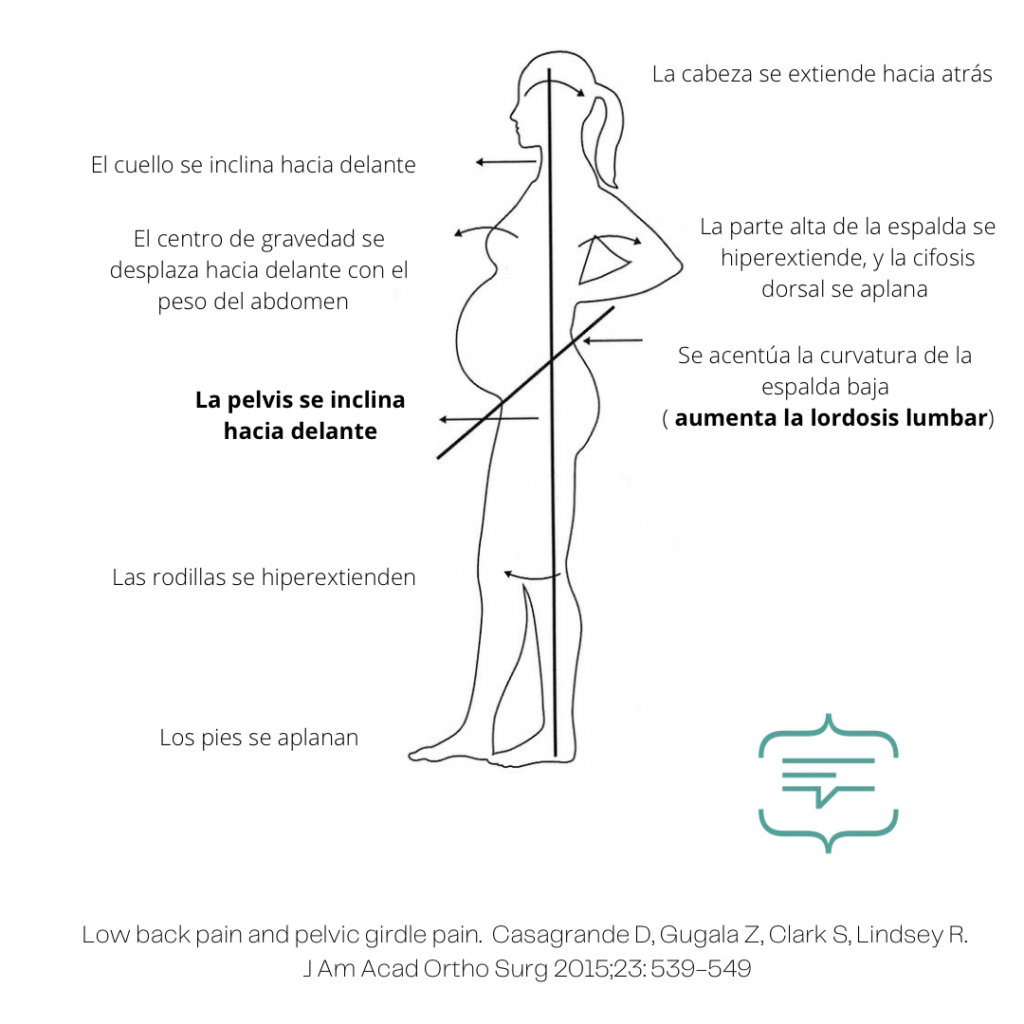
- forward tilt of the neck, which can cause neck pain or tingling in the hands
- the head compensates backwards, causing neck pain and headache
- hyperextension of the upper back with increased tension between the shoulder blades
- forward tilt of the pelvis due to the weight of the uterus, and therefore of the lower lumbar spine, which becomes overloaded
- increased lumbar lordosis to compensate for the weight of the abdomen, which causes pain or pressure in the lower back area
- as pregnancy progresses, relaxin increases, causing joint laxity and further accentuating these compensations.
And what can we do to improve this situation? How can we prevent pain from developing? By trying not to gain more than 11–16 kg, so as to overload the spine as little as possible, especially if you have a history of back pain, are overweight, or are of advanced maternal age.
(*) Low back pain and pelvis girdle pain. Casagrande D, Gugala Z, Clark S, Lindsey R.
J Am Acad Ortho Sur 2015;23.539-540 http://dx.doi.org/10.5435/JAAOS-D-14-00248